

Free Week 3 sample · K–12 with a grown-up
Try a complete money lesson.
Put the learning to work.
Welcome to Earn It, from the Money Pathways Curriculum. Join Jon, watch the short Money Smarts story, then make a safe First-Dollar Plan—and explain the thinking behind it.
Free videos and seven PDFs. No login, payment or email sign-up.
Walkthrough 8:09 · Story 2:53 · Reading and practice add time.
Learn it, try it, explain it.
Start with Jon. Read your age-band pages at the first pause. Watch the story when he introduces it, then return to his walkthrough for practice, discussion and a recap.
- Start with Jon
- Read one age band
- Watch the story
- Return and practice
- Discuss and reflect
Get the right pages ready.
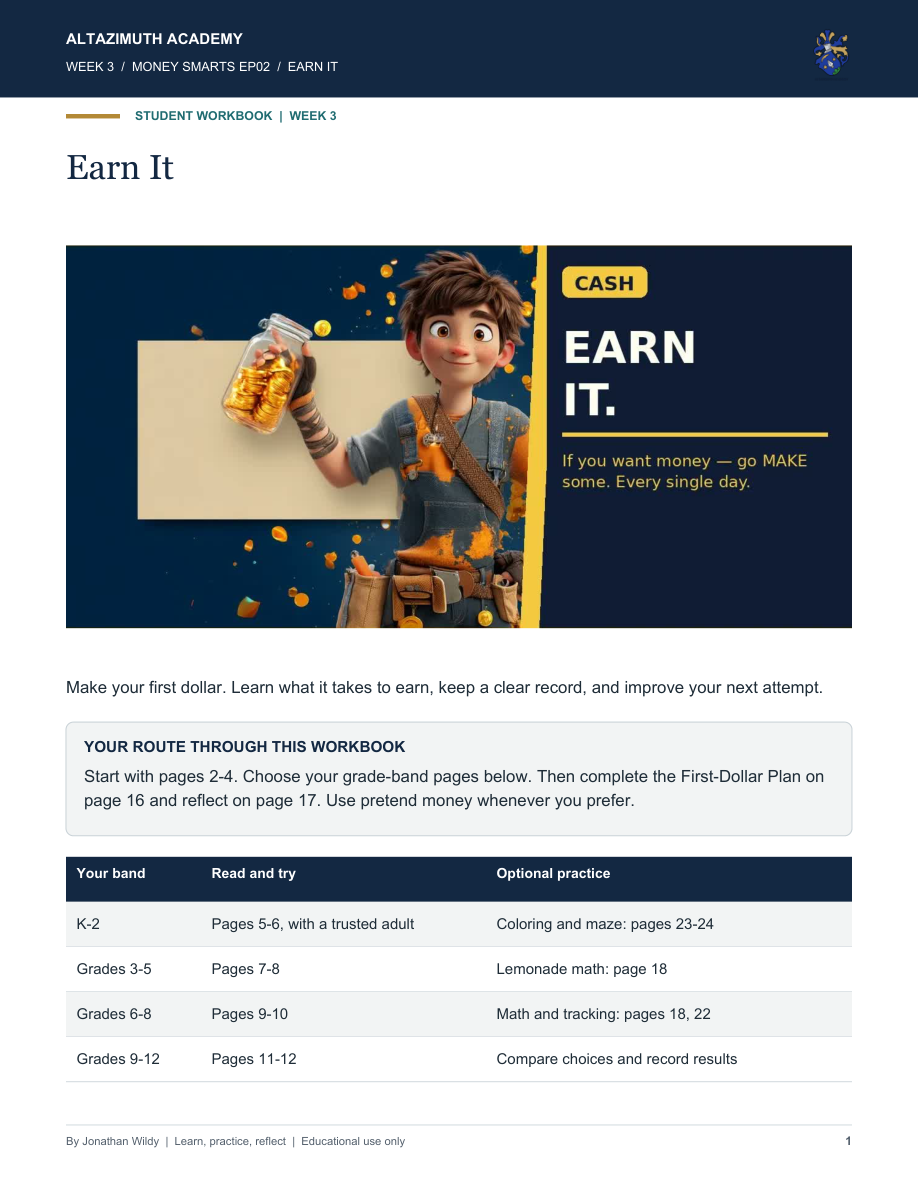
Open the four-page Week 3 Curriculum and Student Workbook. Choose one age band—not all four. Have a pencil and a trusted adult nearby.
Jon's “Student PDF” is the Student Workbook below; his “Parent Guide” is the Family Guide. Student p16 is the First-Dollar Plan. Curriculum printed p16 is My Progress: different files, different pages.
Adult preparation: Skim Family Guide p7 for the 15-minute walkthrough or Educator & Mentor Guide pp2–3 for the age-band map and session plan. You may preview Jon's video first, then follow the learner order below together.
Start with Jon. Pause to read your band.
Play the walkthrough. At “First, read”, follow Jon's pause instruction. Read your band's pages below and preview Student p16, Your First-Dollar Plan. Resume this same video when ready.
Jon's Week 3 walkthrough · 8:09 · Pause for reading, then return after the story. AI presenter and voice used with Jon's permission.
K–2 · Student pp5–6
Agree, do, count and tell
Learn: Name a useful job; distinguish unpaid help, praise and an agreed payment; count a pretend payment and explain the result.
Do: A grown-up reads aloud. Role-play one safe task. Draw or dictate your p16 plan, then mark one practice coin on p6 after trying it.
Adult's role: Model the agreement first. Count the pretend tokens once; a chart coin marks practice, not a payment.
Help: Family pp7, 10 · Educator pp2, 5
Ask: “What useful work could I do safely?”
Grades 3–5 · Student pp7–8
Make a clear, useful offer
Learn: Choose a safe idea, explain whom it helps and what finished means, and separate money received from listed costs.
Do: Choose an earning-menu idea. Put the result, permission, time and pretend payment into p16. Explain the supply cost in the bookmark example.
Adult's role: Ask one clarifying question before accepting the offer. Distinguish ordinary responsibilities from extra tasks paid by agreement.
Help: Family pp7, 11 · Educator pp2, 5
Ask: “What useful work could I do safely?”
Grades 6–8 · Student pp9–10
Tell sales from profit
Learn: Calculate revenue minus all stated costs, notice a missing cost, and compare choices using time and effort as well as money.
Do: Explain $40 sales − $8 costs = $32 profit. Include the additional cost on p10. Make your p16 plan and test another outcome on p18.
Adult's role: Ask what the model leaves out. A calculator is welcome. Setting profit aside does not earn it again.
Help: Family pp8, 14 · Educator pp4, 6
Ask: “What costs or effort go into a simple offer?”
Grades 9–12 · Student pp11–12
Compare opportunities with evidence
Learn: Compare estimated receipts, costs and time; explain a non-money tradeoff and uncertainty; document a skill honestly without exposing private information.
Do: Compare the fictional opportunities, begin a record on p12 and complete p16. Use p18 to test an assumption where useful.
Adult's role: Ask which missing fact could change the choice. Look for honest evidence and a non-money tradeoff.
Help: Family pp14 · Educator pp6, 7
Ask: “How could I compare an offer's likely costs with its expected earnings?”
Finished your reading? Return to Jon and press play. Listen for him to introduce the short story.
Watch the story, then come back to Jon.
When Jon introduces Money Smarts EP02: Earn It—Make Your First Dollar, pause his walkthrough. Watch the separate story below. Notice one earning idea and something it needs: permission, time or supplies.
Money Smarts EP02 · 2:53 · With Cash. Visuals are AI-generated illustrations.
Ask together: “What would need to be agreed before that task?” Connect one story idea to the First-Dollar Plan. Counting and recording help us track money; they do not earn it again. The story is free here, even if the walkthrough mentions access. Family Guide p7 offers an adult-supported alternative if watching is not suitable.
Return to Jon's paused walkthrough and press play from where you left off. Follow his agreement and sales-versus-costs example.
Pause for your First-Dollar Plan.
At “Your turn”, open Student p16. Choose a safe task, pretend business idea or approved resale.
- Name the useful result and who it helps.
- State permission, what finished looks like and timing.
- Estimate money in and costs.
- Role-play a small version, check it and fill in the after-practice rows. Mark invented amounts “pretend.”
K–2 learners draw or dictate, then mark their p6 practice chart. Older learners also use p18 to separate sales from costs and test another outcome.
Coach beside the activity: Family Guide p7: choose and agree → practice → check and record → reflect. Keep the original agreement fair. Praise a specific improvement: “You asked what finished should look like,” or “You remembered the supply cost.” Educator pp4–6 provide worked examples and teaching prompts.
Pause and take the time you need. After the practice, return to Jon and press play.
Talk through how the business works.
Follow Jon's discussion prompt. With an adult, map a made-up business at home, or ask a willing owner about general processes—not private records. Think about supplies, recordkeeping, costs, surprises and what the business might keep or reinvest.
Answer your age-band question with a reason or example.
Keep it age-appropriate: Younger learners name a concrete task and what it needs. Older learners explain why sales are not profit and identify a missing fact. Family pp8 and 14 offer extra examples; Educator pp4–6 provide teaching prompts.
Pause for the conversation, then continue Jon's age-band recap and closing instructions.
Finish with evidence of learning.
Finish the Curriculum pages—not the same-numbered Student Workbook pages.
- My Progress: printed p16 / PDF page 2. Check what you did and name what changed in your understanding.
- My Reflections: printed p17 / PDF page 3. Explain what you did, learned and still want to ask.
- Additional Notes: printed p18 / PDF page 4. Add a connection and a next step to revisit.
Ask for the thinking: “Show me what you decided and tell me why.” Older learners add an assumption or tradeoff. Student p17 offers another reflection; p31 gives a completion check. Educator p7 provides an exit ticket. Praise careful reasoning and honest revision.
Great work. Can you explain these three things?
- One safe, useful idea.
- A reason or evidence for your choice.
- A question or improvement to check next.
A clearer explanation, a safer question or a corrected calculation is real progress. Your core lesson is complete.
Optional practice
A little more, if it helps.
Inside the Student Workbook
P23: color the stand and design an honest sign. P24: follow ASK, PLAN, DO and RECORD through the maze. P25: find the words and connect two to your plan.
Adult answer checks: p33 for concepts and math; pp34–35 for puzzle keys.
Extra K–2 sheet
The four-page Earning and Trading sheet adds a Make/Help sort on p2, exit ticket on p3 and drawing on p4. Keep the distinction clear: not all helping is paid; payment must be agreed first.
Optional older-learner extension
Make a promise worth trusting.
Reputation Capital connects a useful offer to a clear promise, evidence of delivery and respectful follow-up. The assigned excerpt is free in this sample; the full Field Guide is separate.
Middle school
Test one small fictional offer. Is the promise clear? What evidence would show the work was delivered?
High school
Practice an introduction and professional presence for a fictional setting. Record the promise, delivery and respectful follow-up.
Discuss three questions
- What problem does the offer solve?
- What proof would show that the work was delivered?
- What safe, age-appropriate follow-up would build trust?
Reading: Field Guide printed pp208–230 and 236–241 are excerpt PDF pages 1–29; p30 is the sample notice. Record the connection on Curriculum printed p18 / PDF page 4.
Seven printable resources · Open or download
The right resource at the right step.
Adults open the files for learners. No form or email gate. The eight-page Educator Guide is the current sample lesson plan; the 46-page Teacher Guide is additional depth.
Learner pages · Steps 1–6
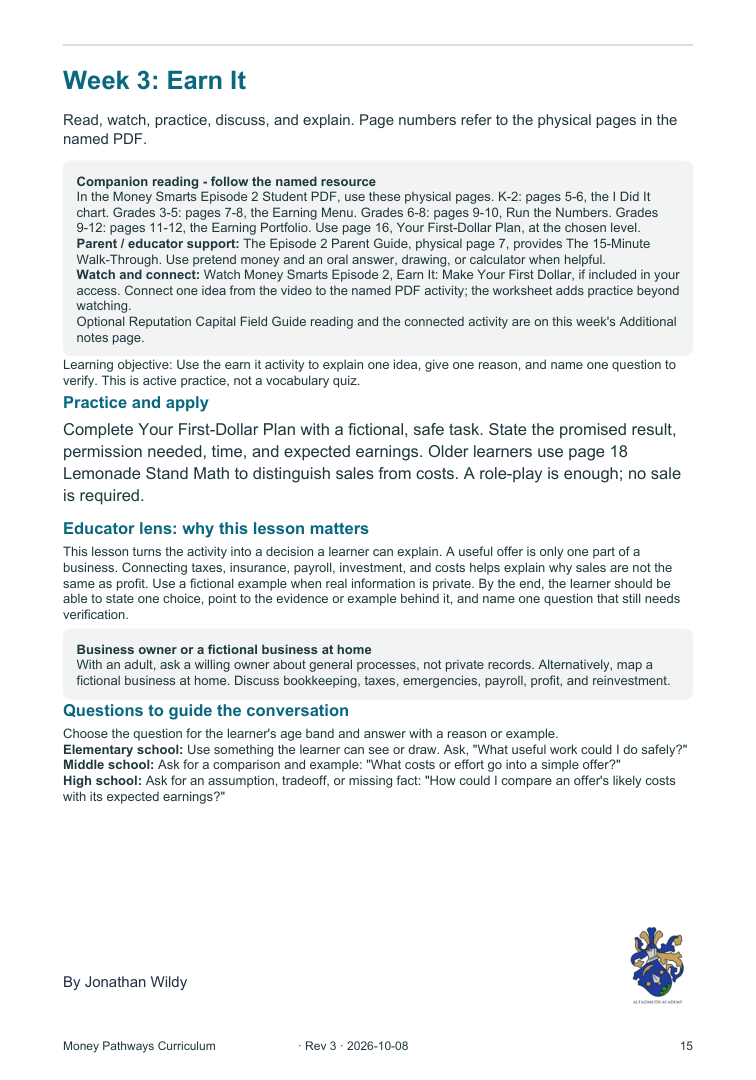
Adult support · Prepare, coach and reflect
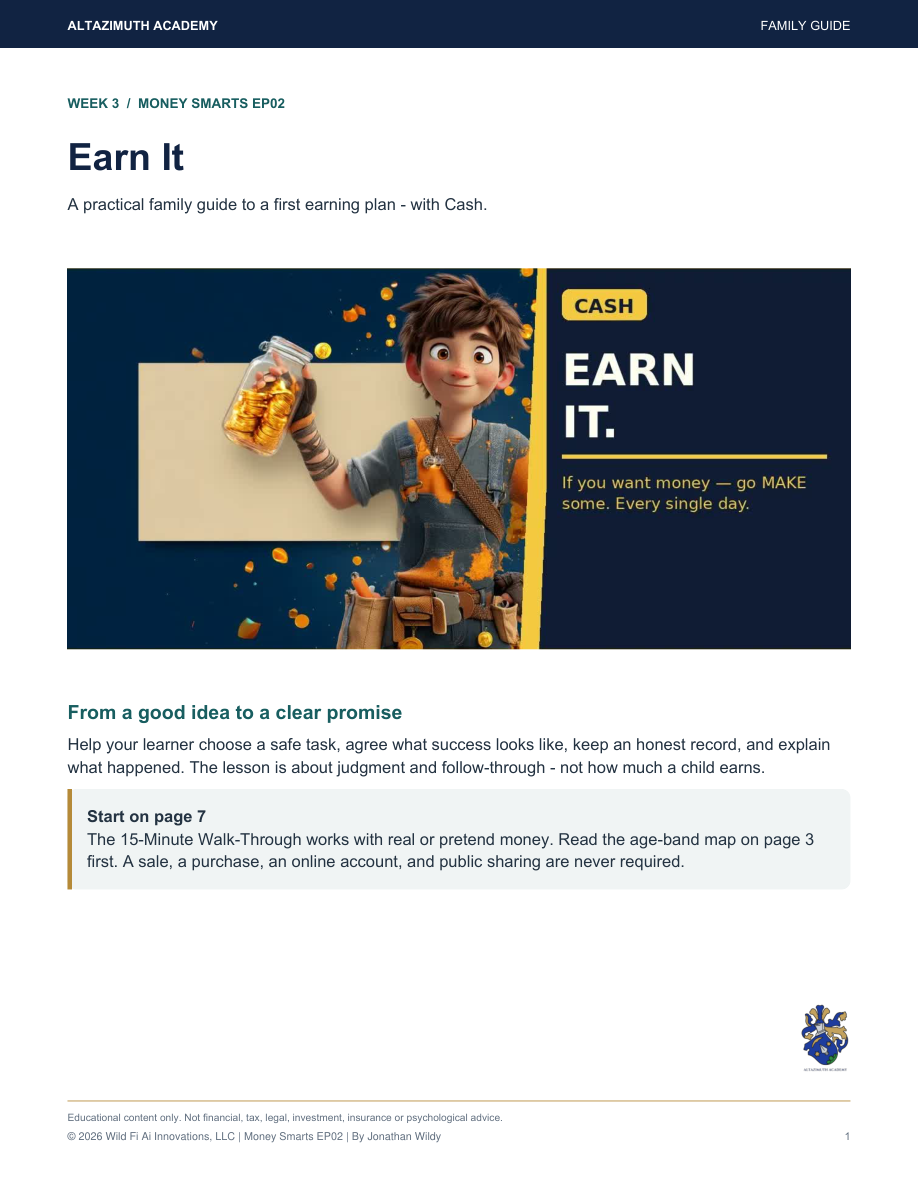
32 pages · Steps 1, 4 and 5
Family Guide
P7 walkthrough, p10 access supports and p14 older-learner examples.

8 pages · Adult preparation and all core steps
Educator & Mentor Guide
Current viewing order, age-band page map, worked examples and assessment.
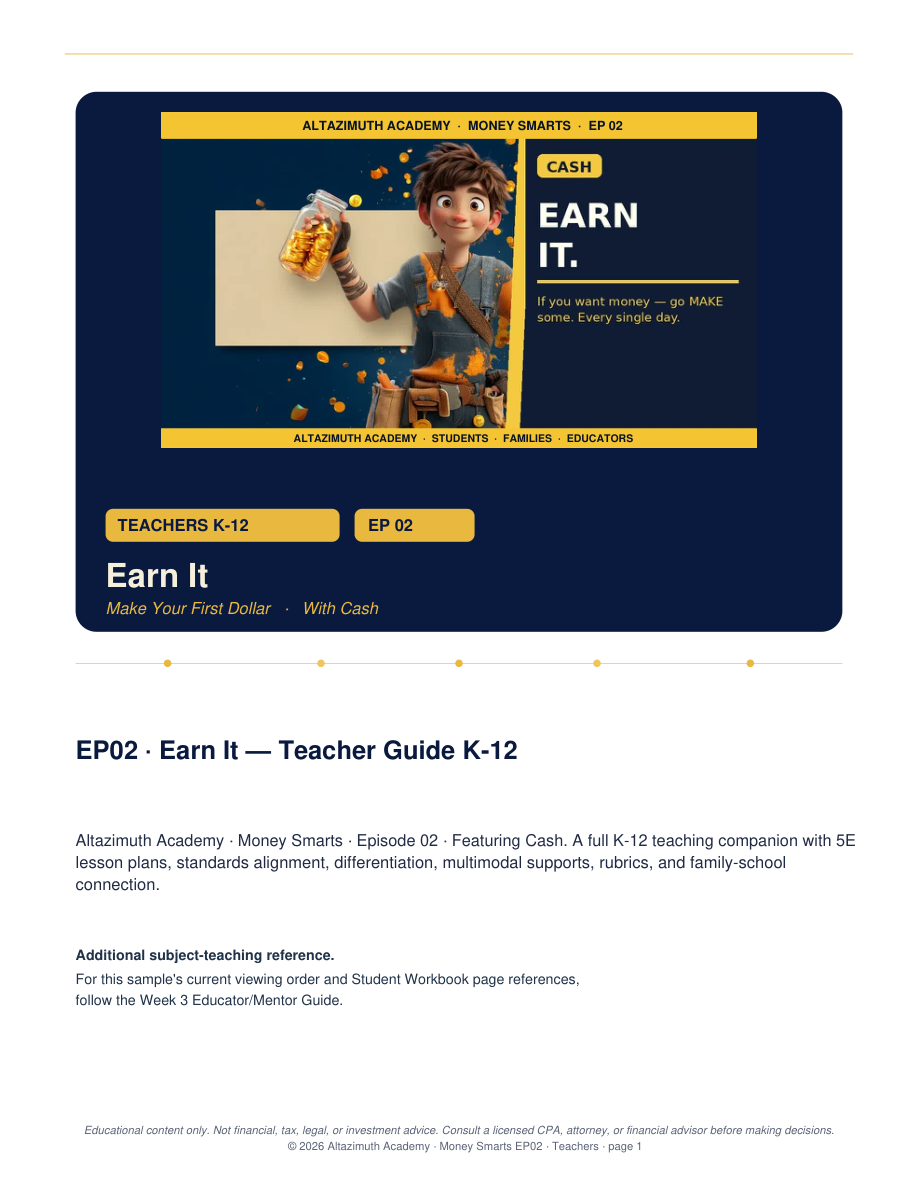
46 pages · Optional teaching depth
Extended Teacher Guide
Additional subject reference. Use the eight-page Educator Guide for this sample's current order and Workbook page map.
Optional practice and extension
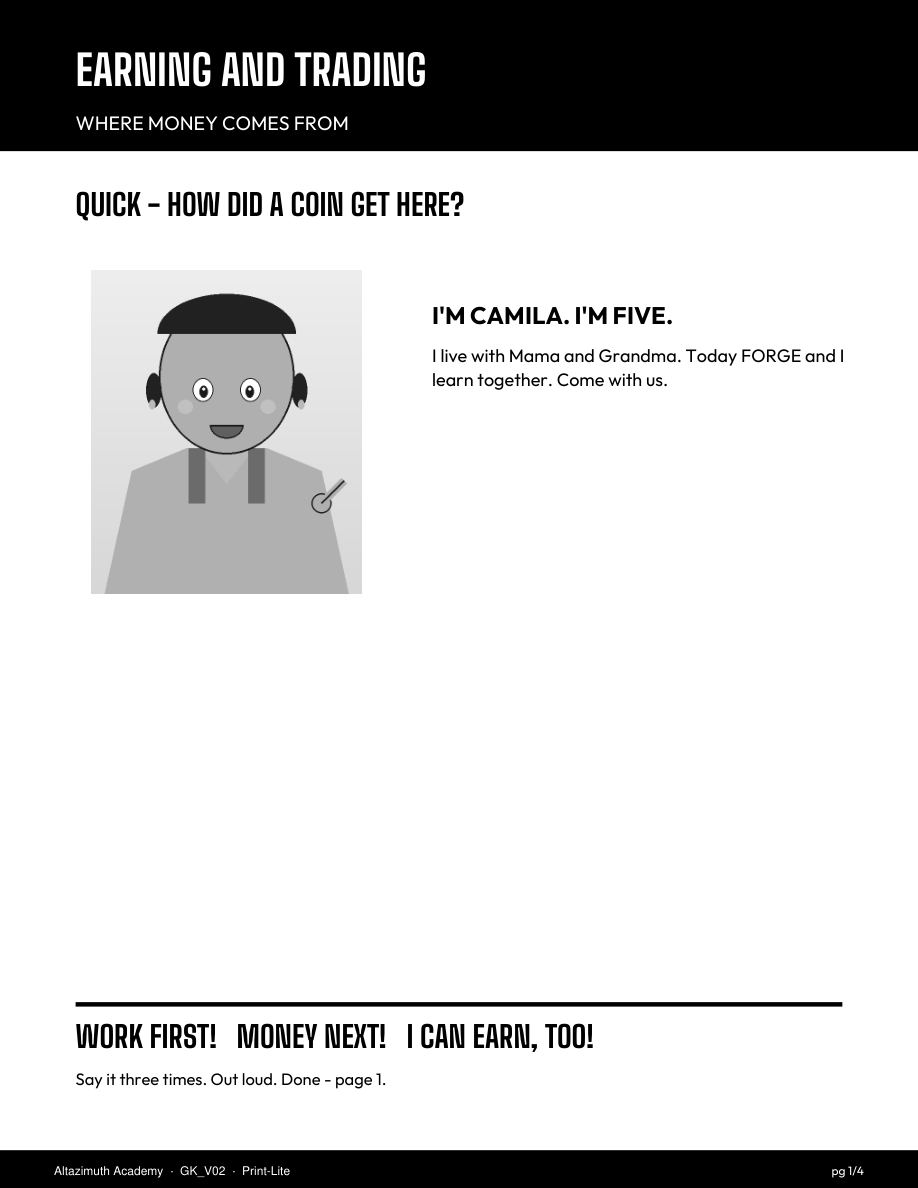
4 pages · Optional after core practice
K–2 Earning and Trading
Make/Help sort on p2, exit ticket on p3 and drawing on p4.
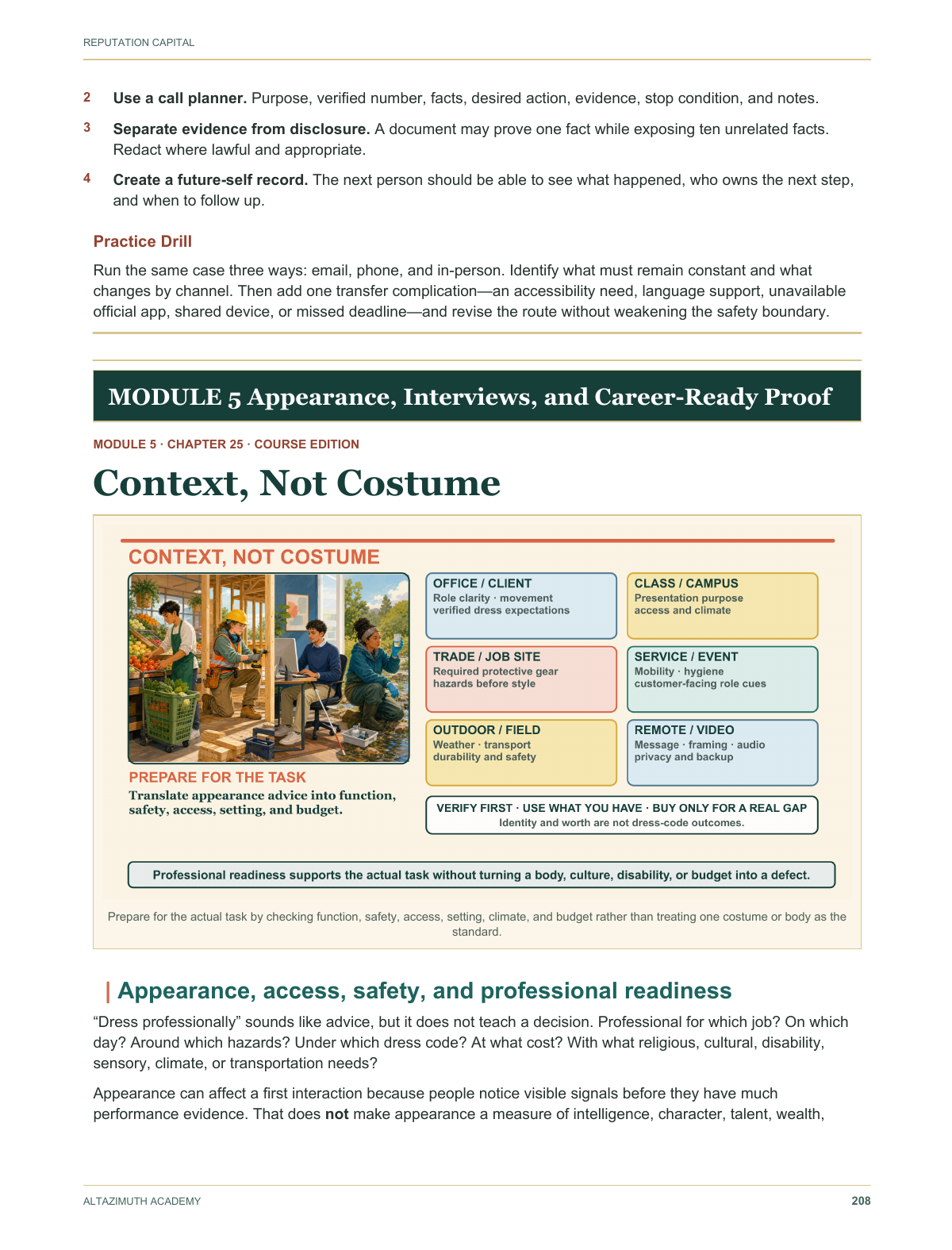
30 pages · Optional older-learner extension
Reputation Capital sample excerpt
29 assigned pages plus the sample notice. Adult-selected; full Field Guide separate.
Ready for the next step?
See how the complete Money Pathways Curriculum connects short lessons, practical activities and conversations across the program.
Educational content only; not individualized financial, tax, legal, employment or investment advice. Use fictional or redacted examples. No public posting, stranger contact or real sale is required. This public sample is designed for adults to use with learners.
© 2026 Wild Fi Ai Innovations, LLC · Altazimuth Academy · Week 3: Earn It · By Jonathan Wildy